
End-to-end secure logistics
Every movement, from rough pickup to polished dispatch, is handled securely.
Complete security, transparent tracking, and expert handling designed specifically for cutting and polishing operations in India.
130+
Countries Served
600+
Cities Across India
12,000+
Pincodes Covered
100%
Shipments Tracked End-To-End
Why factory logistics is different
India processes over 90% of the world's diamonds — primarily in Surat, which is home to thousands of cutting and polishing units ranging from large factories with thousands of workers to small specialist operations. Every one of these units depends on a reliable, uninterrupted flow of rough diamonds coming in, and finished polished stones going out.
When rough diamonds arrive late, production lines slow down. When workers sit idle waiting for material, the factory loses money. When polished stones are not dispatched on time, buyers in Antwerp, Dubai, or Hong Kong miss their market windows. Delays also lead to interest losses, as capital remains blocked in inventory or unsettled transactions. The entire business rhythm of a cutting and polishing unit is tied to the reliability of its logistics.
Most logistics companies in India do not understand this. They treat a factory delivery as just another shipment — no awareness of production schedules, no coordination with multiple suppliers, no understanding of the compliance requirements that apply at every point in the chain. A rough diamond arriving at a Surat factory from an overseas supplier must clear customs correctly. A polished parcel leaving for export must have GST documentation, GJEPC export records, and the correct shipping bill filed through ICEGATE. Get any of this wrong and the factory's entire production cycle is disrupted.
"A cutting and polishing factory does not have the luxury of buffer time. When rough is delayed by two days, two days of production is lost. That cost is real and immediate."
At BVC, we understand that factory logistics is not about moving parcels — it is about maintaining the production rhythm of India's most important manufacturing industry. We coordinate with multiple rough diamond suppliers, consolidate shipments to match factory intake schedules, manage all inbound and outbound compliance, and give factory managers real-time visibility of every movement in and out of their facility.
Approach comparison
These are the most common logistics failures that cutting and polishing factories in India face. Here is what usually happens — and what BVC does differently.
The Challenge
Suppliers dispatch rough when it suits them. Multiple parcels arrive at different times, sometimes on the same day, sometimes days apart. The factory's inventory intake team is constantly chasing arrivals and cannot plan the production schedule properly.
We coordinate with all suppliers against the factory's production schedule — not the supplier's dispatch schedule. Pickups are timed so that rough arrives at the factory in the sequence and volume the production floor actually needs it.
A rough diamond parcel arriving from overseas is held at customs because the importer's GST registration has lapsed, the GJEPC KP documentation is incorrect, or the Bill of Entry does not include the required qualifiers. The factory waits. Production stops.
We verify GJEPC registration, KP documentation, and customs filing requirements before inbound shipments arrive. Our customs team ensures clearance happens on schedule — not after a hold.
Polished diamonds are ready for dispatch but the logistics provider cannot guarantee a pickup time. The shipping bill is filed late. The courier misses the flight. The buyer's order is delayed. The factory's relationship with the buyer takes a hit.
We plan outbound pickups against confirmed export timelines. Shipping bills are pre-filed via ICEGATE. We coordinate with Mumbai and Surat airports to ensure polished parcels make their flight windows — and the buyer receives them on time.
The factory manager has no clear picture of which supplier parcels are in transit, which are at customs, and which are about to arrive. They find out about delays after they happen. Production planning becomes reactive, not proactive.
Our team gives factory managers real-time visibility of every inbound and outbound movement — rough in transit, shipments at customs, polished out for delivery.
Job work invoices between the diamond supplier and the cutting unit are filed incorrectly, or Input Tax Credit on GST paid for rough is not claimed properly. The factory loses money on tax benefits it was entitled to and faces compliance notices.
We work with factory accounts teams to ensure all movement documentation is GST-compliant. Job work transactions are correctly documented. ITC eligibility is preserved, not lost to paperwork errors.
How it works
Click each step to understand what happens at each stage of a cutting and polishing factory's logistics cycle — and what India's compliance requirements look like at each point.
Before any parcel moves, BVC coordinates with the factory's production team to understand what volumes and when.
This planning step is what separates logistics that supports a factory from logistics that just moves parcels. Without it, suppliers dispatch on their own schedule and the factory's production floor is constantly adjusting to irregular arrivals.
What Happens At This Stage
Production Schedule Review With Factory
Documentation And Paperwork Is Arranged
Before any parcel moves, BVC coordinates with the factory's production team to understand what volumes and when.
This planning step is what separates logistics that supports a factory from logistics that just moves parcels. Without it, suppliers dispatch on their own schedule and the factory's production floor is constantly adjusting to irregular arrivals.
What Happens At This Stage
What BVC brings
Here are the key ways BVC keeps a cutting and polishing unit in India running.
Every movement, from rough pickup to polished dispatch, is handled securely.
Supply and production are aligned, enabling rough to reach the factory exactly when needed.
Inbound and outbound compliance handled — so the factory doesn't have to.
Indian regulatory context
These are the compliance requirements that apply every time rough diamonds move into a factory — or polished stones move out. Getting them right protects both the factory's operations and its tax benefits.
Rough diamonds, cut and polished diamonds, and diamond processing services are all subject to GST compliance requirements, while polished diamond exports qualify as zero-rated exports. Diamond manufacturing units must maintain accurate GST documentation and transaction records to support Input Tax Credit (ITC) claims and ensure smooth processing of eligible export refunds.
Reintroduced in April 2025, the DIA scheme allows eligible exporters to import natural cut and polished diamonds under 25 cents duty-free. Eligibility requires Two Star Export House status with USD 15 million annual exports in each of the past 3 fiscal years. Export obligation must be met within 6 months with a 10% value addition.
All rough diamond imports into India require valid GJEPC registration. GJEPC is India's designated Kimberley Process authority. Every shipment of rough must be accompanied by a valid KP certificate, verified by GJEPC at the port of entry before customs clearance.
Since December 2024, Indian Customs requires specific qualifiers — origin, size, shape, type, and colour — in all import and export declarations for diamonds. Factories and their logistics providers must ensure these qualifiers are included in every Bill of Entry and Shipping Bill filed through ICEGATE.
Announced in the 2024 Union Budget, safe harbour rates for foreign mining companies selling rough diamonds in India — particularly at SNZ trading hubs — provide greater tax predictability for overseas suppliers. This is expected to improve the steady supply of rough into Indian cutting and polishing units.
Polished diamond exports from India are zero-rated under GST, allowing factories to claim refunds on input tax paid on rough and manufacturing inputs. Correct Shipping Bill filing and GST return submission are required to unlock these refunds. Errors in export documentation result in refund delays or rejections.
Our Industries
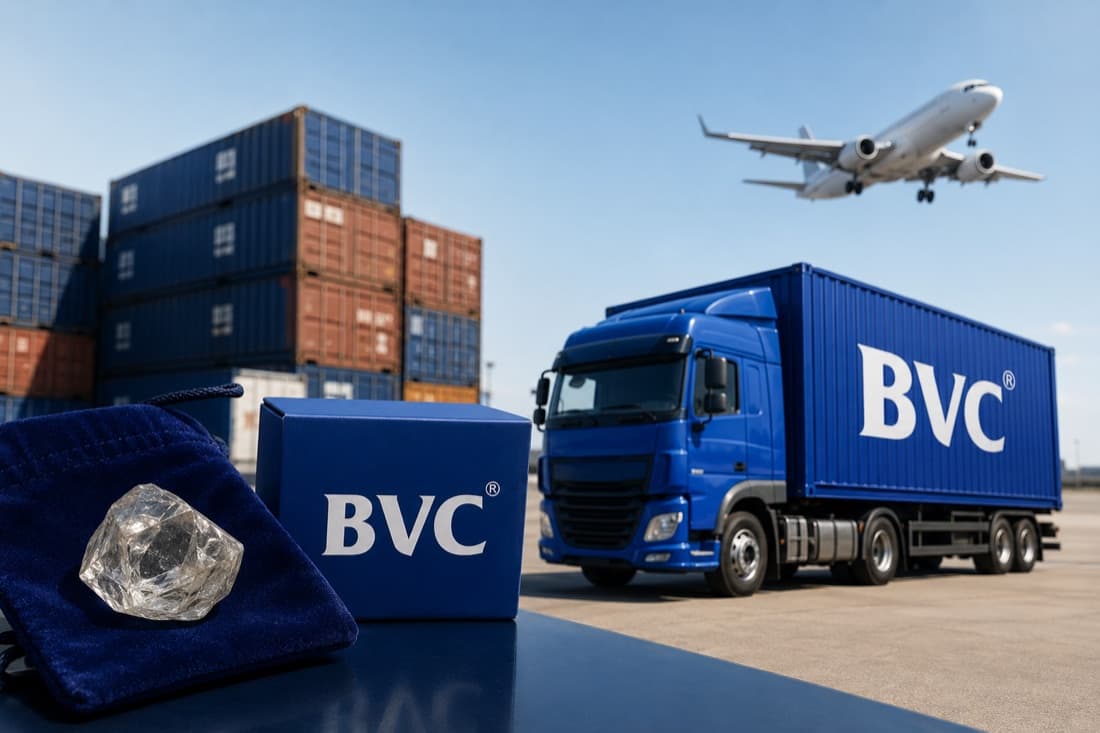
How BVC manages the end-to-end logistics of rough diamond imports — from mine offices abroad to India's diamond bourses.
View More...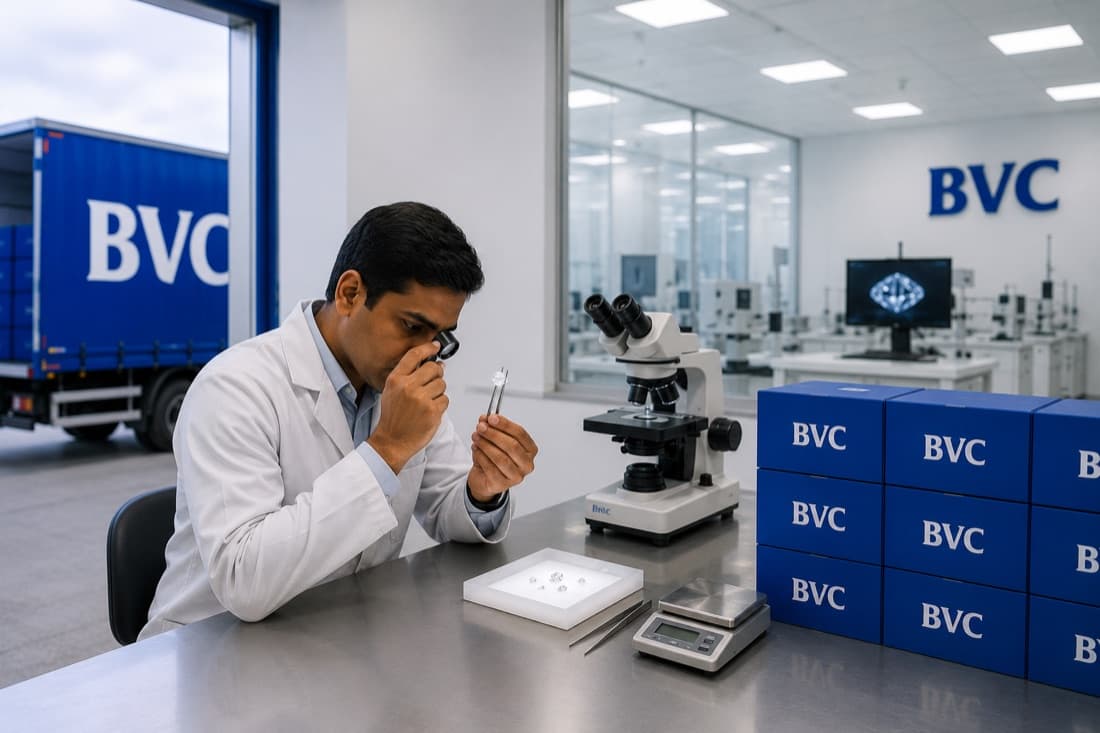
High-value diamond movements between manufacturers, traders, and accredited certification labs — with full control, traceability, and compliance.
View More...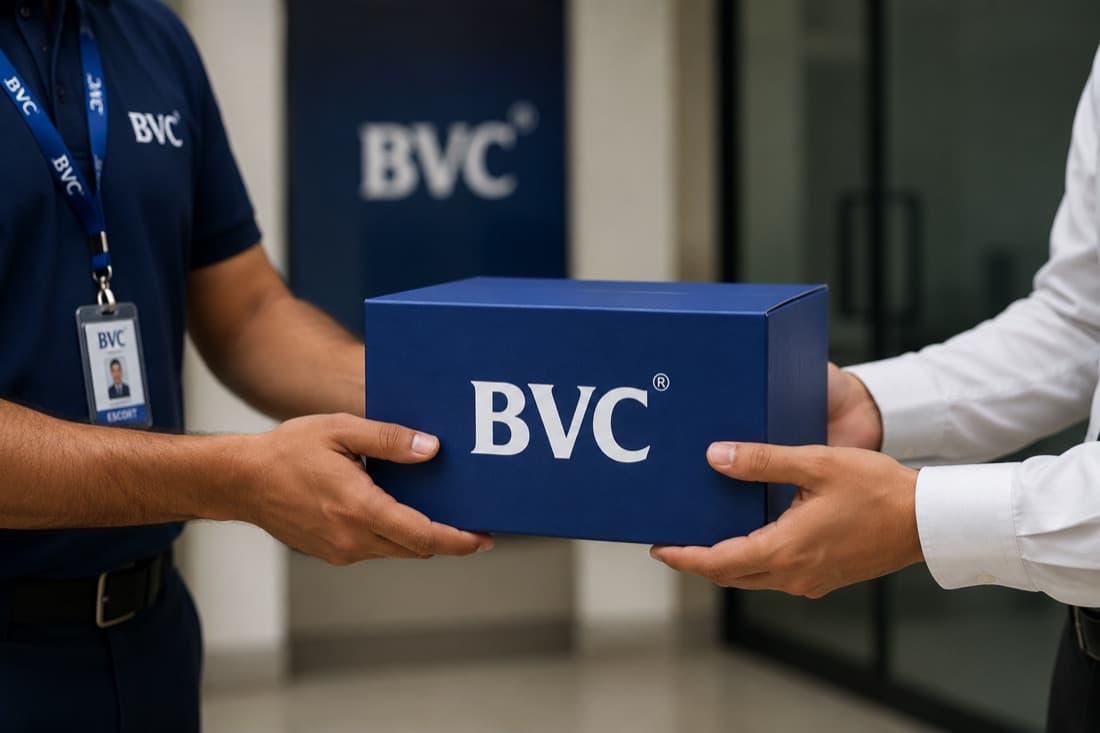
Move diamonds between traders, offices, and bourses with complete security and accountability across India's trading hubs.
View More...Everything you need to know about how BVC keeps rough moving in and polished moving out of India's cutting and polishing units. Can't find your answer? Reach out and our team will help.
Ask Your QuestionDiamond factory logistics services involve the secure movement of rough diamonds, polished stones, export shipments, compliance documentation, and production-linked supply coordination for cutting and polishing units.
We work with mining operators, exploration companies, and trading houses across India's diamond supply chain.