
Oct – Nov
Diwali
India's biggest jewellery buying season. Stores need full displays stocked well before Diwali. Last-minute delivery failures in this window are the most costly of the year.
Peak replenishmentBVC helps jewellery retail chains get the right stock to every store — with HUID records checked, documentation support, and proof of delivery at every location across India.
600+
Cities served across India
12,000+
Pincodes in BVC's delivery network
100%
GPS tracked with proof of delivery
HUID-READY
Documentation checked before every dispatch
Why Retail Chain Delivery Is Different
India's jewellery retail market is growing fast. Chains like Tanishq, Malabar Gold, Kalyan Jewellers, Senco, and CaratLane are opening new stores every month — especially in Tier 2 and Tier 3 cities. Every one of those stores needs fresh stock. Getting that stock from a warehouse to a display case is not a simple job.
Think about everything that has to happen before a piece of jewellery can sit in a store's showcase. It needs to be picked up from the right place. Checked against the store's order. Packed correctly. The BIS hallmark and HUID record for every piece has to be confirmed. The right GST invoice and e-way bill need to be in place if it is crossing state lines. And when it arrives at the store, the store manager needs a signed delivery record they can actually use — for their inventory system and for GST compliance.
For a brand with multiple stores across India this happens dozens of times a week. When any part of it breaks down — wrong pieces, missing HUID records, a consignment held at a check post — the impact lands on the store floor immediately. A store that cannot display a piece cannot sell it.
"The display case is the last step in a very long chain. Every link needs to work. Logistics is one of the most important — and one of the most overlooked."
The Retail Calendar
Jewellery retail demand in India is not flat throughout the year. It spikes hard around specific seasons and festivals — and that is exactly when every store needs its stock on time, with no delivery failures. BVC plans replenishment runs around your retail calendar, not a generic schedule.
Oct – Nov
India's biggest jewellery buying season. Stores need full displays stocked well before Diwali. Last-minute delivery failures in this window are the most costly of the year.
Peak replenishmentApr – May
The second-biggest gold buying day in India. Chains plan weeks ahead to make sure stores in every city have the right stock ready for a single high-demand day.
Pre-season stockingNov – Feb
India's main wedding months drive sustained demand for bridal jewellery. Different regions peak at different times. Chains need flexible, region-by-region replenishment rather than one national push.
Sustained high demandYear-Round
Between peak seasons, stores need regular stock rotation — returns of unsold pieces, fresh arrivals, inter-store transfers when one location is selling faster than another.
Regular cycleApproach Comparison
Using a general courier for jewellery retail distribution is one of the most common sources of operational problems for chains. Here is where it fails, and how BVC handles each situation differently.
A courier moves jewellery from Mumbai to a Kerala store. The consignment is worth Rs. 8 lakh. No e-way bill was generated — the courier assumed the retailer would handle it. A GST officer stops the vehicle at a check post. The consignment is detained. The store misses its replenishment before the weekend.
BVC ensures the shipper has shared the required statutory documents as part of every inter-state dispatch before the vehicle leaves the pickup location. The crew carries complete documentation. Check post stops are resolved on the spot — no detentions, no delays.
A chain dispatches stock for 10 stores in one run. Without store-specific labelling and manifests, the wrong lot ends up at the wrong store. One location is short before a sale. Another has stock it did not order. The confusion takes days to sort out — and another delivery run to fix.
Every package is individually verified, labelled, and kept separately for its specific store at the warehouse, based on store name, address, and order reference. System records enable us to confirm the correct parcel is delivered to the correct store at every step.
Jewellery reaches the store and someone signs a generic delivery slip with a scribble. Weeks later, the accounts team cannot reconcile the delivery with the invoice. In a GST audit, the chain cannot prove which pieces were delivered to which store on which date — a compliance gap that creates real risk.
BVC's digital proof of delivery includes store name, delivery timestamp, store manager's signature, and a parcel-level record of what was received. The retail chain gets a usable delivery record — good for inventory reconciliation, GST returns, and audit — as soon as the delivery is made.
A store returns unsold pieces to the warehouse with a handwritten note. No condition verification. No itemised list. When a piece is reported damaged on return, there is no way to say whether the damage happened at the store, in transit, or at the warehouse. The dispute damages the relationship between the store and central operations.
BVC collects returns with parcel weight capture and condition checks completed at the store, along with signed acceptance. Each parcel is digitally recorded at every step — ensuring clear identification, condition visibility, and complete traceability, protecting both the store and the brand from disputes.
How It Works
Five steps that cover the full cycle of jewellery retail distribution — outbound to stores. Click each step to understand what happens and why it matters.
Before any stock moves, BVC works with the chain's distribution team to build a store-by-store delivery plan: which stores need what, in what quantities, and by when; which routes are inter-state and require specific documentation; and which deliveries need to be timed around festival windows or sale events.
This planning step is where most general couriers fall short—they simply accept a parcel and move it. BVC plans each run like a retail operation, because that's exactly what it is.
Before any stock moves, BVC works with the chain's distribution team to build a store-by-store delivery plan: which stores need what, in what quantities, and by when; which routes are inter-state and require specific documentation; and which deliveries need to be timed around festival windows or sale events.
This planning step is where most general couriers fall short—they simply accept a parcel and move it. BVC plans each run like a retail operation, because that's exactly what it is.
What Gets Planned
What BVC Gives Your Chain
Understand what each capability means in simple business language.
01.
Consistent delivery across every store in your network.
Whether your chain has 5 stores or 500, BVC manages distribution across all of them from a single point of coordination. Every store gets the right stock at the right time — regardless of how many locations are in the network or how different their delivery requirements are.
02.
Paperwork preparation for movement.
BVC checks and supports in preparation of e-way bills, GST invoices, and carrier documentation for each delivery — particularly for inter-state jewellery movements where a missing or incorrect document can result in delays, fines, or detained cargo at a check post.
03.
A usable record — not just a scribble on a slip.
Every store delivery is closed with a digital proof of delivery — store name, timestamp, parcel count, and authorised personnel's signature. Physical and digital records are maintained. The chain receives a consolidated delivery report for all stores in each run, usable for inventory reconciliation and GST audits.
India Angle And Regulatory Context
Jewellery pieces move through retail chains across multiple locations before reaching customers. That makes clear movement and proper records very important.
A self-attested copy of the GST e-Invoice must accompany every consignment of gold and silver jewellery, irrespective of the type of movement. Checkpoint officers rely on this document to verify the sender's tax identity before any other paperwork is examined. BVC attaches this to every consignment file by default.
For branch-to-branch movement of jewellery within the same state, a Delivery Challan under Rule 55 of the CGST Rules 2017 is the correct document — not a tax invoice, because no supply has taken place. The challan must carry the reason ("branch transfer"), the value, and the identifiers of both branches.
When jewellery is moved between branches across state lines, GST treats it as a taxable supply. A GST Invoice for Stock Transfer under Rule 46 of the CGST Rules 2017 is mandatory, and IGST applies even though no external sale has occurred. BVC structures these inter-state branch transfers with the invoice, the e-way bill, and the matching insurance declaration as one packet.
A Delivery Challan under Rule 55 of the CGST Rules 2017 travels with every high value shipment, without exception. It records what is physically leaving the premises, its value, and where it is going — irrespective of whether a sale is happening, whether it is an internal transfer, or whether the piece is going for repair. Customer generates this challan at the point of dispatch for every single shipment.
A No Sale Declaration of Goods accompanies every jewellery shipment to formally state that the movement itself is not a sale transaction. This protects the jeweller from the consignment being mistaken for an undeclared taxable supply at a checkpoint, and it clarifies the intent of the movement for any officer inspecting the goods in transit. BVC attaches this declaration by default to every consignment file.
On top of the baseline paperwork, an E-Way Bill is required for inter-state jewellery movement above the prescribed threshold, and for intra-state movement in states that have notified e-way bill requirements for precious metals under CGST Rule 138F. BVC tracks which states have notified this requirement and generates the e-way bill wherever applicable.
The correct HSN code must appear on every GST invoice and every delivery challan that moves with a jewellery consignment. Gold jewellery, silver jewellery, coins, bars and studded pieces each have their own HSN classification, and the code dictates the applicable GST rate and the audit treatment of the consignment. A missing or incorrect HSN is one of the most common reasons a jewellery shipment is held up at a checkpoint or flagged in a post-audit review.
Our Industries
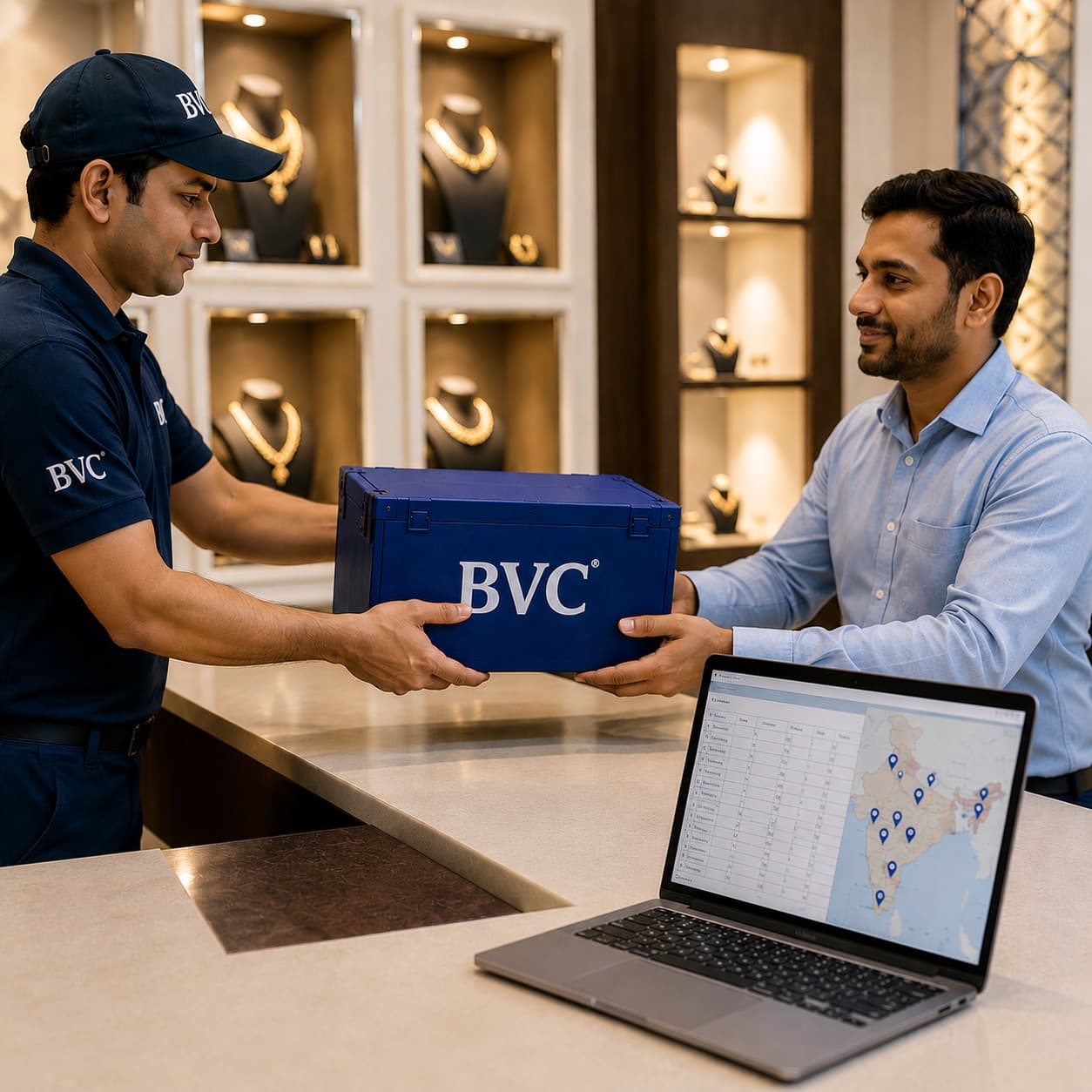
Moving gold, silver, and diamond pieces from one pickup point to many retailers across India — safely, on time, with full records.
View More...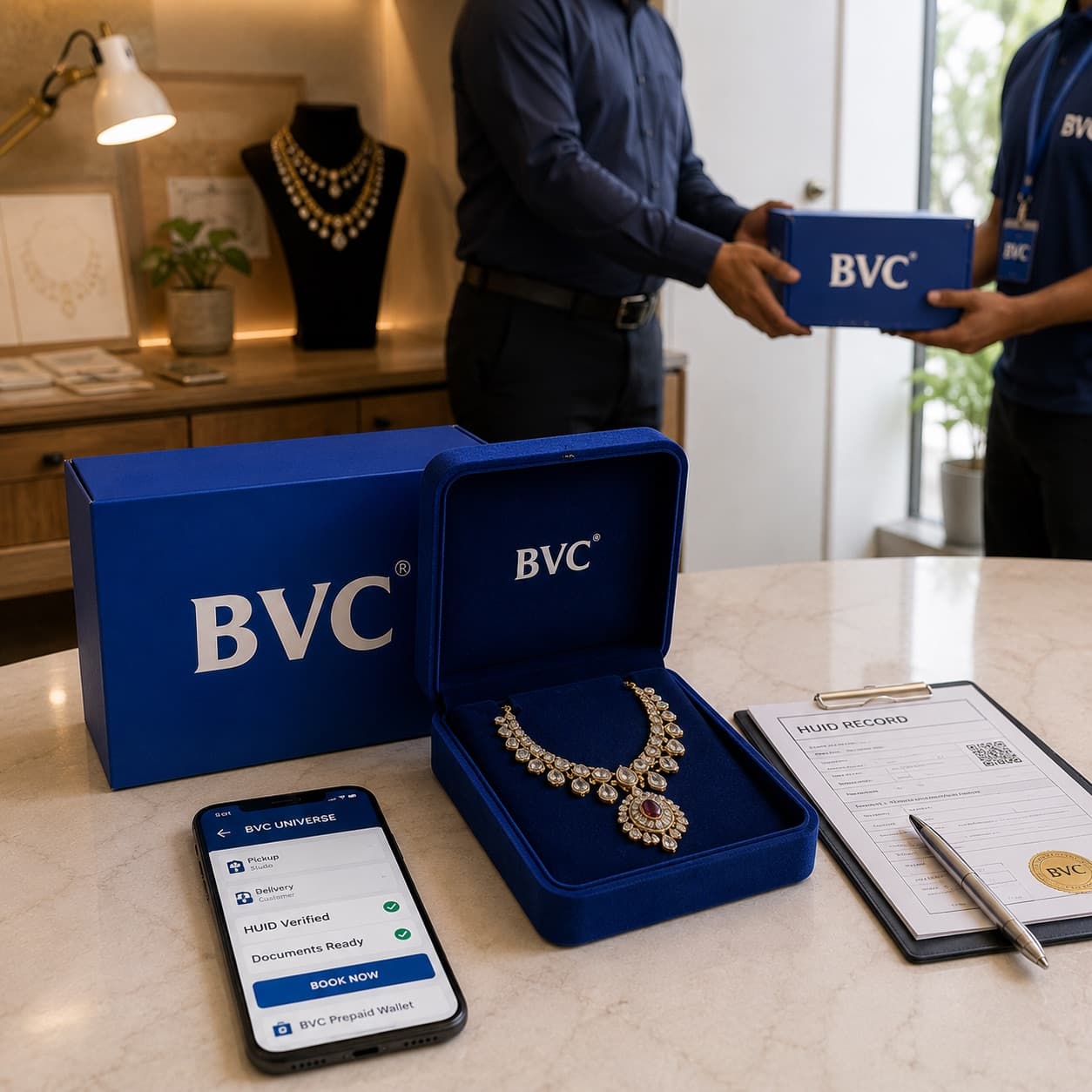
Picking up bespoke and custom jewellery from your studio and delivering it to your end customer — documents ready, signed proof of delivery at the door.
View More...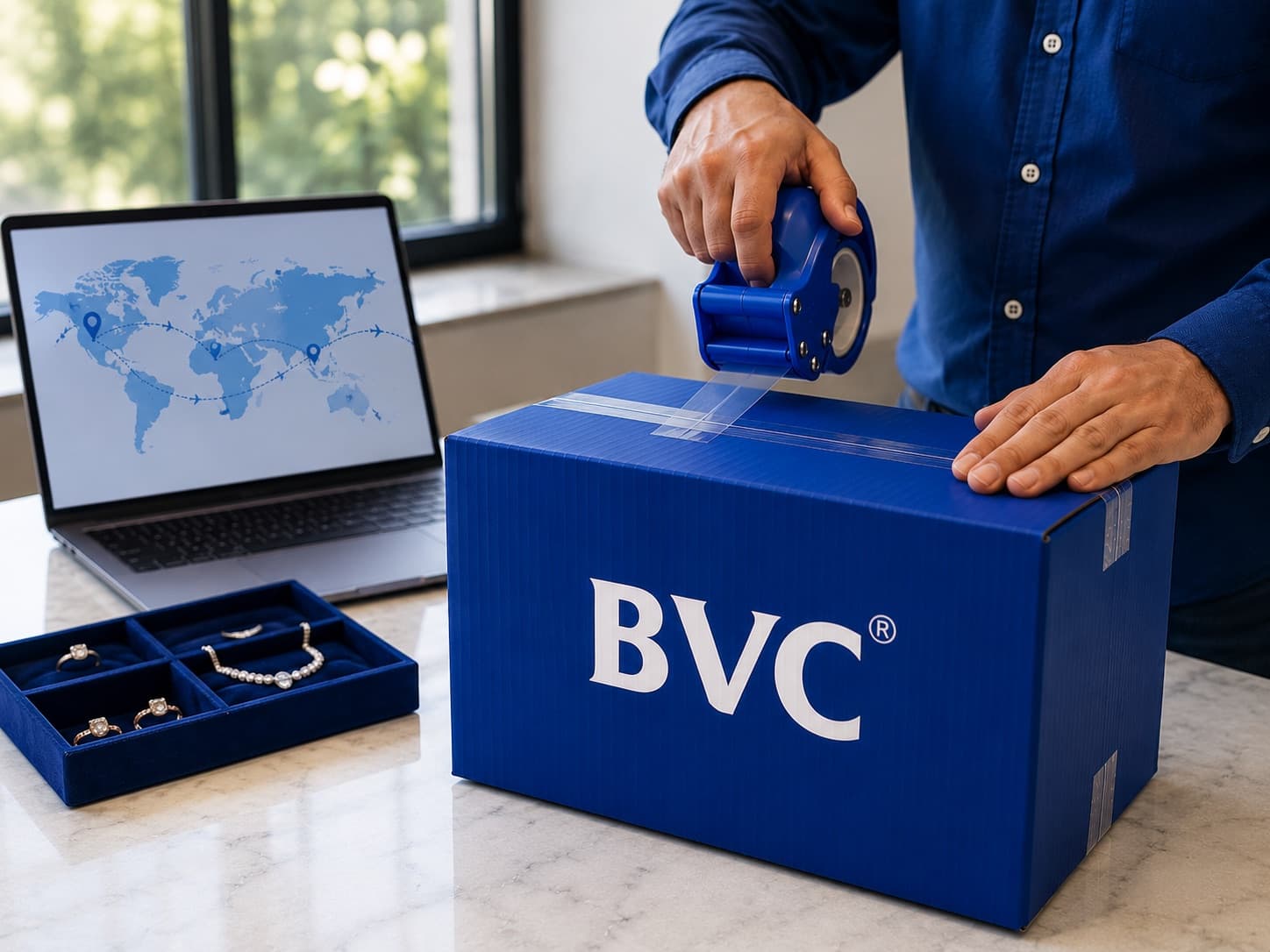
Shipping jewellery to customers across India and around the world — every order insured, every delivery tracked, every return managed securely.
View More...Everything you need to know about distributing jewellery to retail chains across India with BVC. Can't find your answer? Reach out and our team will help.
Ask Your QuestionHUID stands for Hallmark Unique Identification number. Since April 2023, every gold jewellery piece sold in India must carry a 6-digit HUID engraved on it — linked to the BIS hallmarking system. When jewellery is delivered to a store, HUID records must accompany each piece so it can be registered in the store's inventory and put on display legally. A piece without HUID documentation cannot be sold until the records are corrected.
Talk to BVC about getting the right stock to every store — on time, with HUID records checked, documentation supported, and proof of delivery at every location. Whether your chain has 5 stores or 500, we can build a plan around your network.